
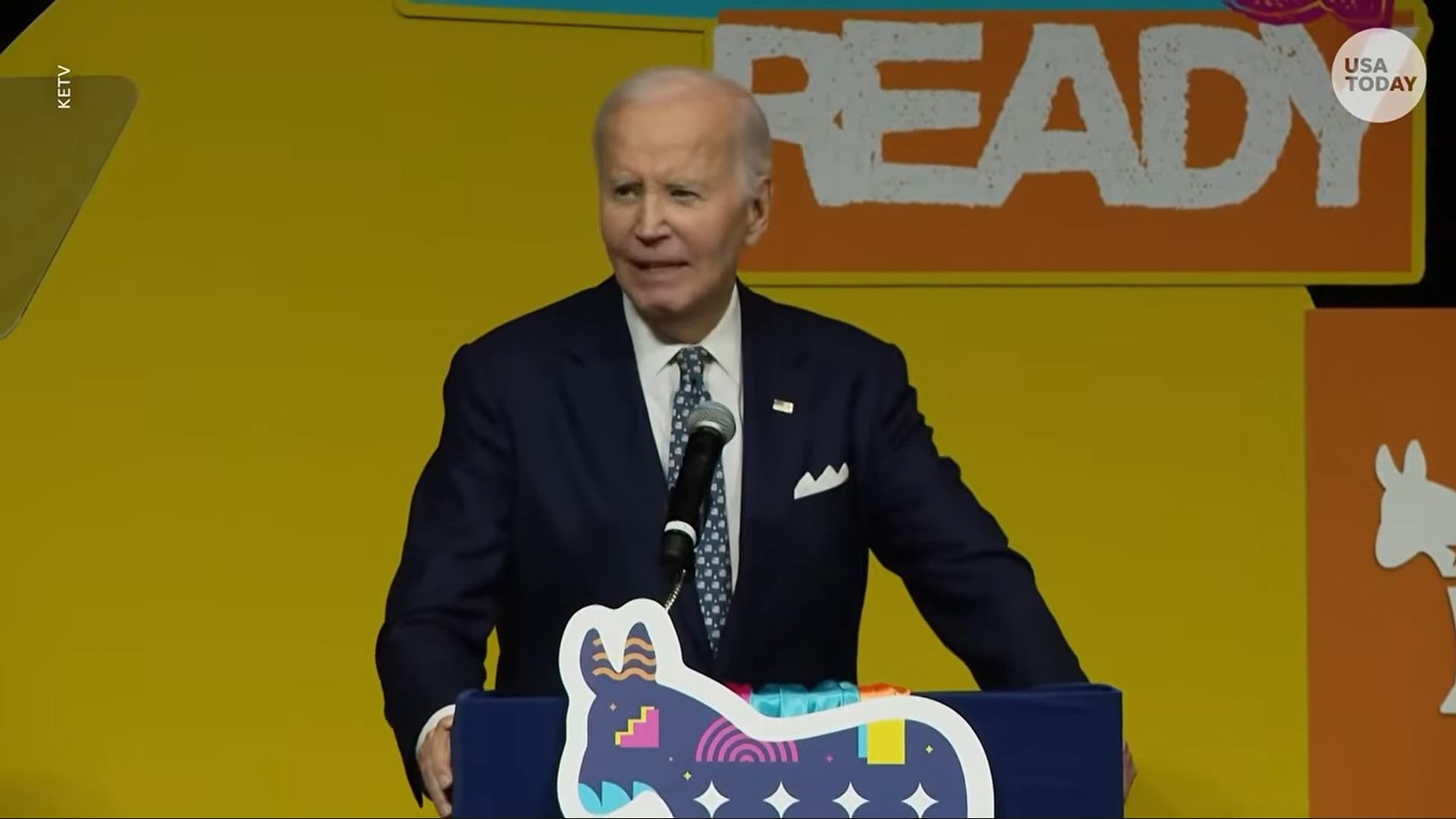
A federal appellate court on Monday shot down Joe Biden’s bid to block the release of audio recordings and transcripts of conversations he had with his memoir ghostwriter prior to becoming president.
Read more Planned Parenthood Ramps Up Child Vivisection Thanks To More Tax Dollars From GOP Congress
In a , a panel for the D.C. Circuit Court of Appeals rejected Biden’s emergency motion for an injunction pending appeal to prevent the disclosure of the records and audio of his 2016-2017 discussions with his writing partner Mark Zwonitzer while preparing his 2017 book. The majority was comprised of Chief Judge Sri Srinivasan (Obama appointee) and Judge Gregory Katsas (Trump appointee), while Judge Florence Pan (Biden appointee) dissented.
“We accordingly conclude that Biden has not shown a likelihood that the requested materials must be withheld from disclosure,” the majority wrote.
As noted by Srinivasan and Katsas, the legal dispute over the contested materials can be traced to 2023, when then-Attorney General Merrick Garland appointed Special Counsel Robert Hur to probe Biden’s handling of classified materials “during and after” his time as vice president. It was “under an agreement limiting their use to the Special Counsel’s investigation” that the Biden Justice Department acquired the audio recordings of Biden’s discussions with Zwonitzer and “prepared transcripts of the recorded conversations.”
As The Federalist previously reported, Hur concluded in his 2024 report “that no criminal charges are warranted” in his investigation into Biden’s mishandling of classified materials despite his team finding records “related to foreign policy in Afghanistan and handwritten notes ‘implicating sensitive intelligence.’” Federal authorities justified their refusal to charge Biden because the then-president “would likely present himself to the jury, as he did during our interview with him, as a sympathetic, well-meaning, elderly man with a poor memory.”
“Based on our direct interactions with and observations of him, he is someone for whom many jurors will want to identify reasonable doubt,” prosecutors wrote at the time. “It would be difficult to convince a jury that they should convict him — by then a former president well into his eighties — of a serious felony that requires a mental state of willfulness.”
That same year, the Heritage Foundation and Mike Howell, the president of Heritage’s Oversight Project, brought action under the Freedom of Information Act (FOIA) to obtain the audio recordings and transcripts. As noted by Srinivasan and Katsas, the Biden DOJ “withheld the bulk of the requested materials, citing several FOIA exemptions.”
In February 2026, however, the Trump DOJ “reversed course and represented that it intended to disclose the materials, with redactions, to Plaintiffs and the House Judiciary Committee.” It was at that point at which Biden filed legal action seeking a preliminary injunction to block their release. The former president’s request was denied by the U.S. District Court for the District of Columbia last month.
Read more Being Nice Instead Of Godly Is A Theology For Losers
In their ruling rejecting Biden’s emergency motion for an injunction, Srinivasan and Katsas laid out several qualifications the former president must meet before such relief can be granted, such as showing a likelihood of success on the merits of his arguments and that he is likely to suffer “irreparable harm” in the absence of an injunction. After assessing Biden’s arguments that “he is likely to succeed on the merits,” the two appellate judges concluded that “he has not made that showing,” and subsequently “den[ied] his motion.”
“The central question on the merits is whether Biden is likely to succeed in showing that a FOIA exemption applies to the requested materials and that the Privacy Act thus bars their disclosure. While the requested recordings were not government records when originally created by Zwonitzer and Biden in connection with the preparation of Biden’s 2017 memoir, it is undisputed that they became subject to FOIA’s disclosure mandate when the Special Counsel obtained possession of them as part of his investigation,” the court ruled.
Srinivasan and Katsas also shot down Biden’s claims that the DOJ’s decision to disclose the recordings and transcripts “is arbitrary, capricious, and an abuse of discretion in violation of the [Administrative Procedure Act] APA.” The two judges agreed with the district court’s determination that Biden’s arguments “are unlikely to succeed” and noted that the DOJ “displayed awareness that it was changing position, explained that its reason for doing so was in part based on its making additional redactions to the requested materials, and reasonably weighed the interests at stake.”
In her dissent, Pan argued that Biden “‘is not required to prove his case in full’” at this stage of the case’s proceedings, and that the appellate court’s task “is not to ‘conclusively determine the rights of the parties’ — rather, we should merely ‘balance the equities as the litigation moves forward.’” She further claimed that the majority did “not address the mootness problem” and “instead focus[ed] exclusively on [Biden’s] likelihood of success on the merits, which they view as an independent and sufficient basis to deny the injunction.”
“I would consider the preliminary-injunction factors more flexibly under the well-established ‘sliding scale’ approach, which provides that when the other equities weigh in a movant’s favor, and he can show irreparable harm, he ‘need not necessarily show a 51% likelihood of success,’” Pan wrote. “In any event, I disagree with my colleagues’ evaluation of Biden’s likelihood of success on the merits.”
The D.C. Circuit panel paused its decision until Aug. 3 to permit Biden time to consider another appeal “if he wishes.”
Read more ‘Dark-Money’ Abortion Drug Dealer Hub Referred To Trump DOJ For Criminal Investigation