
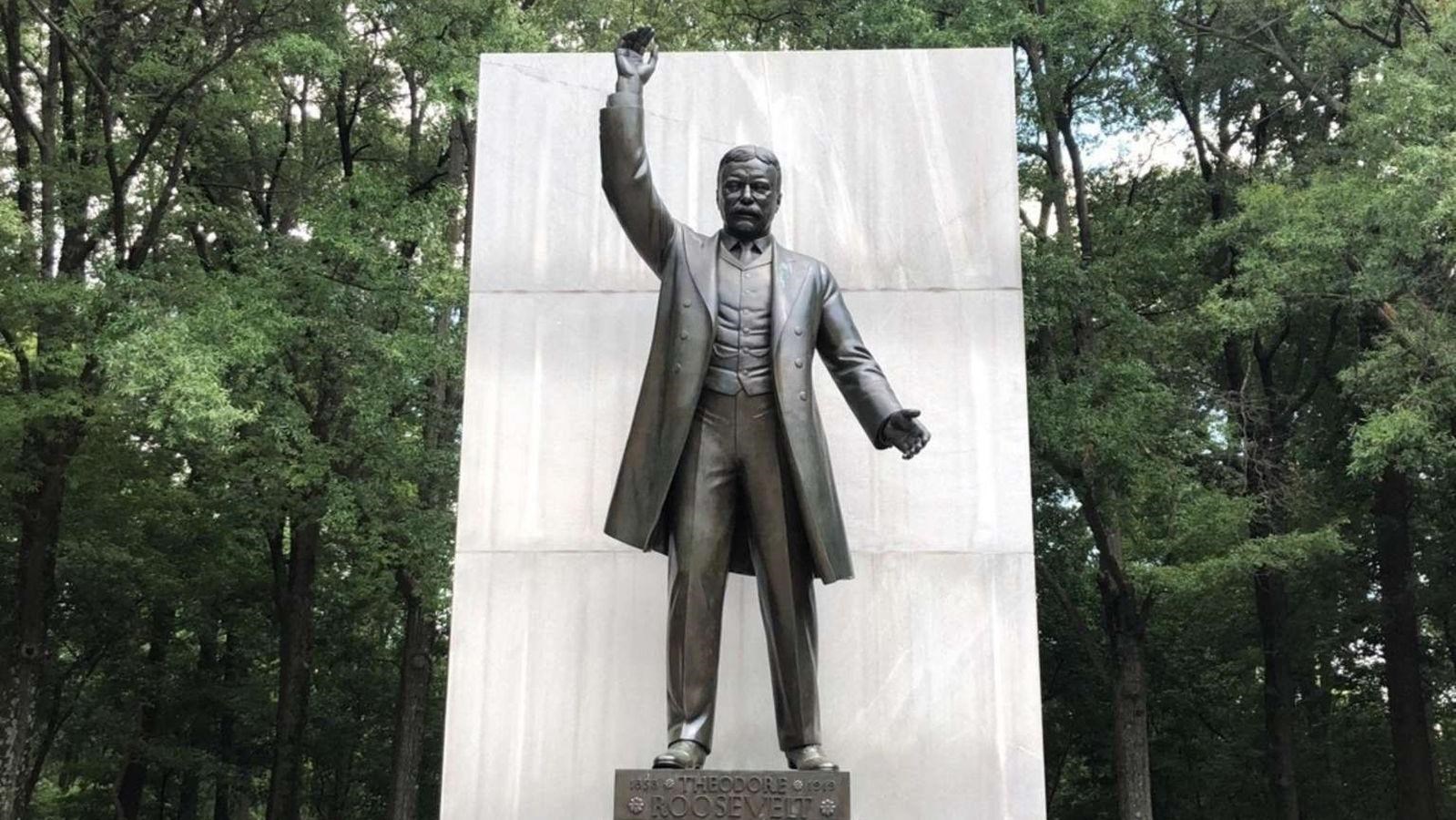
Chris Bray, a senior correspondent at The Federalist, wrote a sharp and I think largely fair piece about the new Theodore Roosevelt Presidential Library. He walked out of it angry, and his central complaint is worth taking seriously: every figure in that building gets run through the progressive machine and handed back as a 2026 Democrat complete with a love for big government, equity, and plenty of state-sanctioned “fairness.”
Read more Joe Biden’s Autopen Has Written A Memoir
His advice by the end is to admire the lobby, but “skip all the things with words on them.”
While I agree with the sentiment of the piece — the museum seems to either disavow or omit his conservative, pro-American stances — I don’t think the museum misrepresented Roosevelt by painting him as a progressive proto-Obama.
That’s who Roosevelt was.
Two things can be true at the same time. Theodore Roosevelt was a Republican president; he believed it necessary for immigrants to assimilate, and he signed laws to restrict immigration. But he was also a founder of the Progressive Party and held many beliefs shared by my least favorite president ever, Woodrow Wilson.
I hate Woodrow Wilson. Not dislike. Hate. Because Wilson knew exactly what he was doing. He knew the evils that progressivism could trick America into, and he pushed hard for every single one of them.
Roosevelt was different. He was standing at the front edge of the scientific era. He watched science and “the experts” start to look like the answer to everything. Government started to look obsolete next to them. And his beliefs about eugenics — more on that later — are absolutely terrifying. But I don’t think he foresaw the horrors it would lead to, just a few short decades later.
Most Americans will recognize the iconic statue of Theodore Roosevelt on horseback, which stood at the entrance of the American Museum of Natural History in New York City. It features a Native American on one side, an African man on the other, and Roosevelt towering above them on horseback.
It stood there from 1940 until 2022, when the museum and the city decided it was racist and needed to be removed. They shipped it to North Dakota on a “long-term loan.” And now, its new home, the Theodore Roosevelt Presidential Library, is also refusing to show it.
The TR Library opened a few weeks ago, on Independence Day. It claimed that the statue was just too big to display during the opening on such short notice. But the library is in no hurry, since it also finds the statue to be “problematic in its composition.” And it will first need to “establish an Advisory Council composed of representatives of the Indigenous Tribal and Black communities, historians, scholars, and artists to guide the recontextualization of the statue.”
So yes, the museum seems to be picking and choosing which parts of TR’s legacy need “recontextualization” for a modern audience, and which can be presented without comment, or even with a smile.
But removing and hiding the statue of Roosevelt — who helped popularize progressivism — doesn’t erase the sins of the horrible men who followed in his footsteps and tested his theories. The American Museum of Natural History in New York City should be familiar with those men. After all, it proudly supported them.
In September 1921, the museum hosted the Second International Congress of Eugenics. The museum’s president, Henry Fairfield Osborn, presided over it personally. To publicize it, the museum partnered with Charles Davenport, who ran the Eugenics Record Office at Cold Spring Harbor, a terrifying operation that screened American families for “defective” bloodlines and recommended which ones should be sterilized or barred from reproducing. Carnegie money helped pay for it. Charles Darwin’s own son gave an address. They built a whole exhibition in the museum, full of charts and family pedigrees, arguing that “the wrong sort of immigrant” was degrading the “American stock.”
It went so well that they did it again in 1932. In the same building.
The museum that removed a statue in 2022 because “the experts” believed it expressed a racial hierarchy is the same institution that hosted “the experts” for a conference built to scientifically prove that hierarchy. Twice!
A few years later, the Nazis would take that “science” those elites cultivated in America and use it to slaughter millions. They thanked us for it. That’s the real legacy of progressivism.
And here’s the harder truth that I think Bray’s piece missed: That’s part of Roosevelt’s legacy too.
On January 3, 1913, working as an editor at The Outlook, former President Roosevelt wrote to Charles Davenport on Outlook letterhead. He called two eugenics studies “instructive” and “ominous,” then wrote that “society has no business to permit degenerates to reproduce their kind.”
He said we “refuse to apply to human beings” the same knowledge a farmer applies to his stock and called that refusal madness. No farmer, he argued, would let his herd breed indiscriminately. He wrote that “the inescapable duty of the good citizen of the right type is to leave his or her blood behind him in the world,” and that society had “no business to permit the perpetuation of citizens of the wrong type.”
Read more Tillis Doesn’t Understand Difference Between Biden’s Weaponized DOJ And Trump’s Pursuit Of Justice
This was the “settled science” of the day, and Theodore Roosevelt believed in it. He championed “the science,” “the experts,” and a government strong enough and clever enough to act on what those experts said. That’s progressivism, laid out in one letter.
Was he good on national parks? Yes. Genuinely good. Was he brave, funny, and sharp? Yes — the man read a book a day, and sometimes more. He took a bullet in Milwaukee and finished the speech anyway. None of that is the argument. The argument is what he believed the American government was for.
In Columbus, Ohio, on February 21, 1912, Roosevelt gave a speech he called, “A Charter for Democracy.” In it, he proposed that when a court strikes down a progressive statute, the people should be able to vote to overturn the court.
Here was a former president of the United States, a Republican at that, proposing a popular recall of judicial decisions. The Constitution be damned! The Bull Moose campaign ran on the same fuel: separation of powers is just a speed bump, and the will of the people, correctly interpreted by the right people, doesn’t have to slow down for it.
I’m not arguing that Roosevelt was a despicable man like Woodrow Wilson was (that’s a hill I will die on). I don’t think Roosevelt fully saw where this was going. Wilson did, and he didn’t mind.
Wilson taught that “government isn’t a machine, but a living thing … accountable to Darwin, not Newton.” To him, the Constitution was an organism that had to evolve.
When he talked about the Declaration of Independence, he told audiences, “do not repeat the preface.” That’s the “all men are created equal” part, the God part. He knew exactly what he was cutting out. You cannot build an expert administrative state on top of rights granted by a creator, because rights that come from God can’t be revoked by a commission of experts. So, the preface had to go.
And without God, government became a monster.
In Buck v. Bell (1927), the Supreme Court ruled 8-1 that Virginia could sterilize Carrie Buck, who the state had deemed “feeble-minded.” The opinion was written by Oliver Wendell Holmes Jr. — the great progressive legal mind of his generation. He wrote, “Three generations of imbeciles are enough.”
More than 60,000 Americans were sterilized under laws that traced back to that ruling. When Germany drafted its own sterilization statutes under Hitler in 1933, they modeled them on ours.
Progressivism didn’t fall out of the sky in the 2000s. It has been running for more than a century, and the engine hasn’t changed once: you are a category, a type, a stock, a unit, a number — improvable or disposable by people with better degrees than you.
That’s who Roosevelt was, just as much as he was a protector of our forests and a believer in assimilation.
The Theodore Roosevelt Presidential Library should put both sides on full display. If they’re going to highlight his progressive beliefs, highlight all of them. Because an increasing portion of the modern Democratic Party’s leadership has embraced a very dangerous idea that he helped popularize.
It’s not social welfare. It’s that the American people are livestock to be managed.
The Declaration says the opposite — that you are endowed by your Creator, before any government ever laid eyes on you, with rights that NOBODY has the authority, pedigree, or “expertise” to take away.
Those are two very different roads. One leads back to that sentence about “imbeciles,” and the other keeps going forward.
[READ: The Teddy Roosevelt Presidential Library Shows How Deeply The Left Captured Our Cultural Imagination]
Read more ‘It’s Not An Oops’: Critics Call For Firing Of Incompetent Wisconsin Election Official